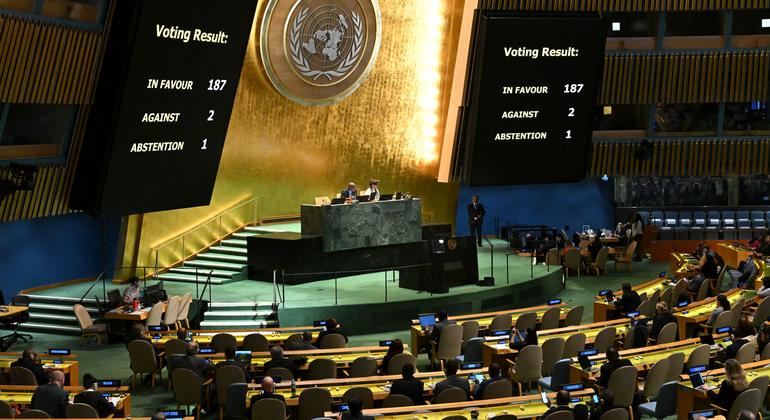


In a significant yet familiar call to action, the United Nations General Assembly has renewed its demand for the United States to end its longstanding economic embargo on Cuba. This appeal, raised consistently since 1992, underscores a growing international consensus that the decades-old sanctions are overdue for reevaluation.
During the recent Assembly session, representatives from numerous countries expressed concerns over the impact of the embargo on the Cuban people, particularly highlighting its effects on health, education, and economic stability. Proponents of lifting the embargo argue that it disproportionately harms ordinary Cuban citizens, while its political effectiveness remains widely debated. The embargo, which restricts U.S. businesses from conducting trade with Cuba, was initially imposed in 1960 following the Cuban Revolution and was expanded into a full economic embargo in 1962.
With the Assembly’s vote, a broad array of nations aligned in favor of ending the embargo, reflecting widespread disapproval of the measure. However, as in previous years, the resolution is largely symbolic; the U.N. vote holds no binding authority over U.S. policy decisions, which ultimately require Congressional action.
Despite the enduring deadlock on this issue, the General Assembly’s annual resolution continues to shine a global spotlight on U.S.-Cuba relations. Advocates hope that mounting international support may eventually encourage U.S. leaders to consider policy shifts, especially as calls for renewed diplomacy grow.
“UN General Assembly Urges U.S. to Lift Decades-Long Embargo on Cuba”